


Plain distilled gin contains no measurable sugar. A standard shot carries roughly 97 calories from alcohol alone, not carbohydrates, and regulatory rules for London dry gin keep added sweetening to trace amounts. The exceptions worth knowing are flavoured gins, liqueurs and whatever you pour into the glass with it.
TL;DR:
- Most dry gins contain negligible sugar due to distillation, with regulatory limits ensuring added sweeteners stay below 0.1 grams per liter.
- Flavored gins and liqueurs can contain up to 1.8 grams of sugar per liter, especially if sugar is added for flavor or color after distillation.
- The calorie content of a typical 44-milliliter serving of 80 proof gin is about 97 calories, coming solely from alcohol, not carbohydrates.
- Mixing gin with high-sugar tonics or syrups significantly increases overall sugar and calorie content, but switching to plain soda water or zero-sugar tonics prevents this.
- Alcohol can impact blood glucose levels independently of sugar content, so diabetics should consult clinicians and monitor levels when drinking gin.
Table of Contents
- Why pure gin contains no sugar
- Sugar content in gin: what a standard serve looks like
- When gin contains sugar: flavoured gins and liqueurs
- How mixers change the sugar and calorie total
- Can diabetics drink gin? Practical guidance
- How we think about sugar-conscious gin drinking
- View our sugar-free distilled gins
- Sources
- FAQ
Why pure gin contains no sugar
Distillation is the whole answer. Gin starts life as a fermented base, usually grain, where yeast converts sugars into ethanol. By the time that liquid hits the still, the fermentable sugars are largely already gone, and what remains behind in the pot is the heavier, non‑volatile material, including any residual sugars and solids. Only the ethanol, water and aromatic vapours rise up through the still and condense back into liquid. That process is basic chemistry: sugar molecules don’t vaporise at the temperatures used in gin distillation, so they simply can’t travel with the alcohol.
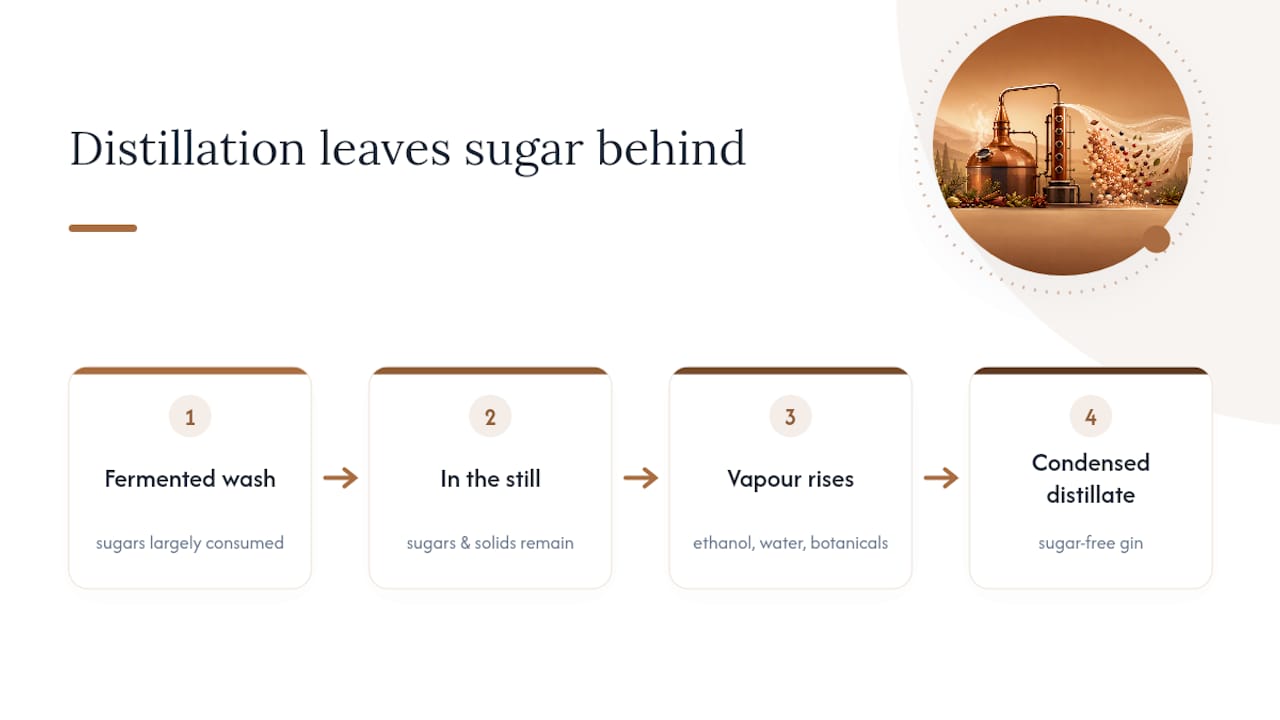
This is also why distilled spirits are carbohydrate free as a category, not just a marketing line specific to one brand. The flavour you taste in a well-made gin, the juniper, citrus peel, coriander seed, whatever botanicals the distiller has thoughtfully selected, comes from aromatic oils carried in the vapour phase, not from dissolved sugars.
Regulation backs this up. Under the standards for London dry gin, distillers can add sweetening only up to about 0.1 grams per litre, an amount so small it doesn’t register on any nutrition label. That’s part of why so many widely sold dry gins are, by definition, effectively sugar free before you even check the bottle. Fermentation itself deserves a mention too. It’s the stage where sugars are consumed, and how yeast drives that process explains why the raw material going into the still is already stripped of most of its sweetness.
Sugar content in gin: what a standard serve looks like
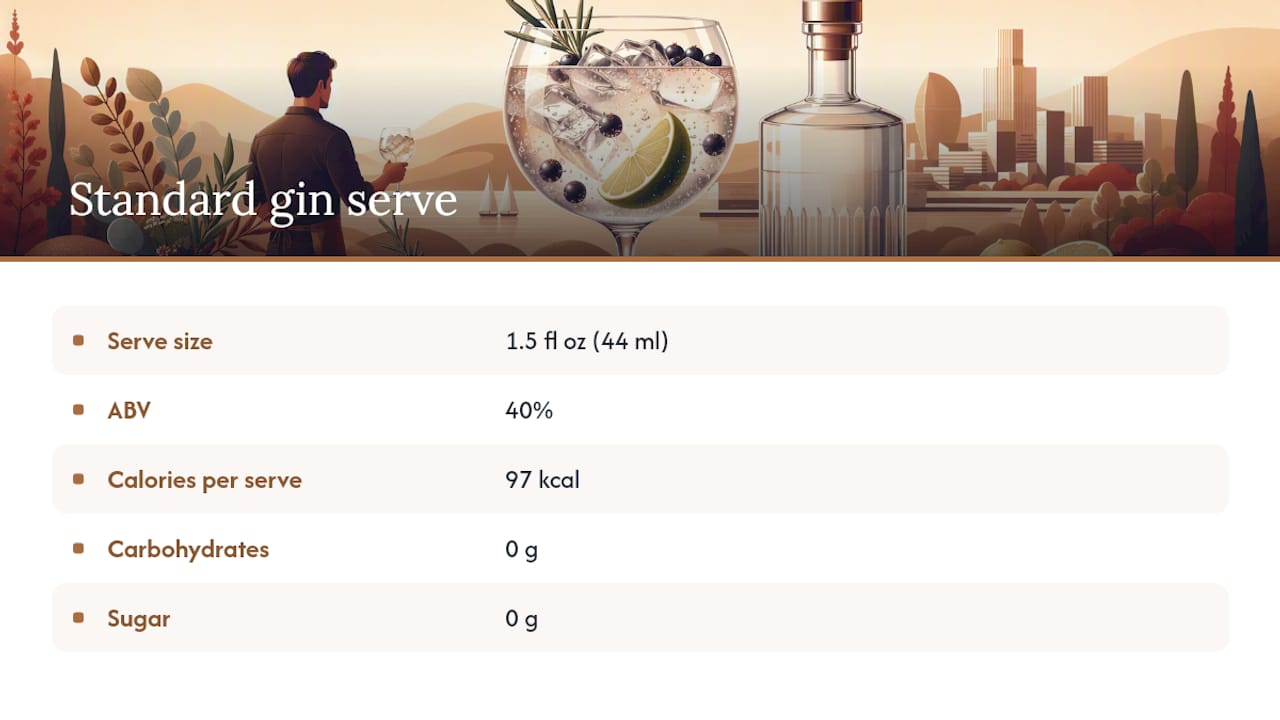
A standard serve is 1.5 fluid ounces, or 44 millilitres, of 80 proof gin (40% ABV). That pour delivers about 97 calories, zero grams of carbohydrates, and zero grams of sugar. Every calorie in that glass comes from ethanol, not from any dissolved carbohydrate, which is a distinction worth understanding if you’re counting either.
Alcohol calories don’t behave like food calories. Your body treats ethanol as a priority fuel and metabolises it ahead of fat, protein or carbohydrate, which is one reason regular drinking can complicate weight management even when the sugar content reads as zero. For anyone tracking macros closely, this is where serving size and strength start to matter more than sugar ever does: a heavier pour or a higher ABV bottle means more alcohol calories, even though the carbohydrate count stays flat.
That’s also the detail that makes gin genuinely workable for keto and other low-carb diets. Because plain gin contributes nothing to your daily carb total, the mixer is the only variable left to manage. It’s a simple equation once you see it laid out, and it’s why so many people on carb-restricted eating patterns default to gin over sweeter spirits without a second thought.
When gin contains sugar: flavoured gins and liqueurs
Plain dry gin is one thing. Flavoured gins, sloe gin, and gin liqueurs are another matter entirely. Sloe gin is technically a liqueur, not a gin in the strict regulatory sense, and it’s made by steeping sloe berries and sugar in gin, which means it carries real sugar content by design. Old Tom gin, a sweeter historical style still made by some distillers, sits somewhere in between: some versions add sugar during production, others rely on botanicals for a rounder mouthfeel without added sweetener, so the two bottles on the shelf can behave very differently.
Laboratory testing backs up the concern with flavoured varieties specifically. Analyses of commercial flavoured gin samples have found sugar levels up to around 1.8 grams per litre, confirming that added sugar in this category is real, not theoretical. Craft or small-batch branding doesn’t guarantee otherwise either. Some boutique flavoured gins add sugar post-distillation purely for mouthfeel or colour, so a premium price tag tells you nothing about sugar content on its own.
A few checks before you buy:
- Look for the word “gin” alone on the label, not “gin liqueur” or “sloe gin” if you want the sugar-free version.
- Check the ABV. Liqueurs are typically lower proof than standard gin, often a signal that sugar has replaced some of the alcohol.
- Read the nutrition panel when one’s provided. Zero grams of sugar should be stated plainly, not implied.
How mixers change the sugar and calorie total
Here’s the part that catches most people out: the gin was never the problem. Regular tonic water can carry as much sugar as a soft drink, and once you add that to your gin, the total sugar and calorie count is being driven almost entirely by the mixer, not the spirit sitting quietly at zero grams. A gin and tonic made with full-sugar tonic can easily carry more sugar than a standard soft drink serve, while the same gin topped with soda water adds nothing but bubbles.
The fix is straightforward once you know where to look:
- Swap standard tonic for a zero-sugar tonic or plain soda water.
- Use fresh citrus, a squeeze of lime or a twist of orange peel, instead of syrupy pre-made mixers.
- Watch your pour ratio; a heavy hand on tonic adds up faster than a heavy hand on gin.
- Check the tonic label the same way you’d check the gin’s, since sugar content varies widely between brands.
As one mixology resource puts it, the “total package,” spirit plus mixer plus serving size, is what actually determines whether your drink fits a low-sugar diet. Get the mixer right and a gin and soda with fresh lime is about as close to a sugar-free cocktail as you’ll find.
Can diabetics drink gin? Practical guidance
Plain gin itself contains no sugar to spike blood glucose directly, but that doesn’t make it automatically safe to drink without thought. Alcohol affects blood glucose independently of sugar content, and it can interact with diabetes medications in ways that aren’t always predictable. Health guidance consistently recommends that people managing diabetes discuss alcohol with their clinician before making it a regular habit, and that advice holds even when the drink in question is technically sugar free.
If you do choose to drink, a few habits reduce the risk: stay hydrated alongside your gin, monitor your blood glucose in the hours after drinking rather than assuming zero sugar means zero effect, and avoid drinking on an empty stomach. Alcohol can also affect how your body handles carbohydrates over the following hours, which is worth understanding if you’re tracking recovery or fitness goals alongside blood sugar management. Choosing low-sugar mixers isn’t optional in this context; it’s the one variable you fully control.
How we think about sugar-conscious gin drinking
We built our collection around a simple idea: flavour should come from real botanicals, carefully distilled, not from sugar or additives doing the heavy lifting. Where we do add fruit character, in lines like Tropical Trim, we’re upfront that the flavour profile differs from our dry-style bottles, and we’d rather you check the nutrition panel than take our word for it.
That transparency matters more to us than any single sales figure. We’d rather a health-conscious drinker trust the label than trust the marketing.
— Winston
View our sugar-free distilled gins
If you’re building a low-sugar bar cart, three of our bottles are worth a look. Skinny Jeans Gin and Slim Crop Gin are both plain distilled styles crafted for drinkers who want bold botanical flavour without added sugar, while Tropical Trim Gin offers a fruit-forward option worth checking against its own nutrition panel before you assume it matches the dry-style bottles.
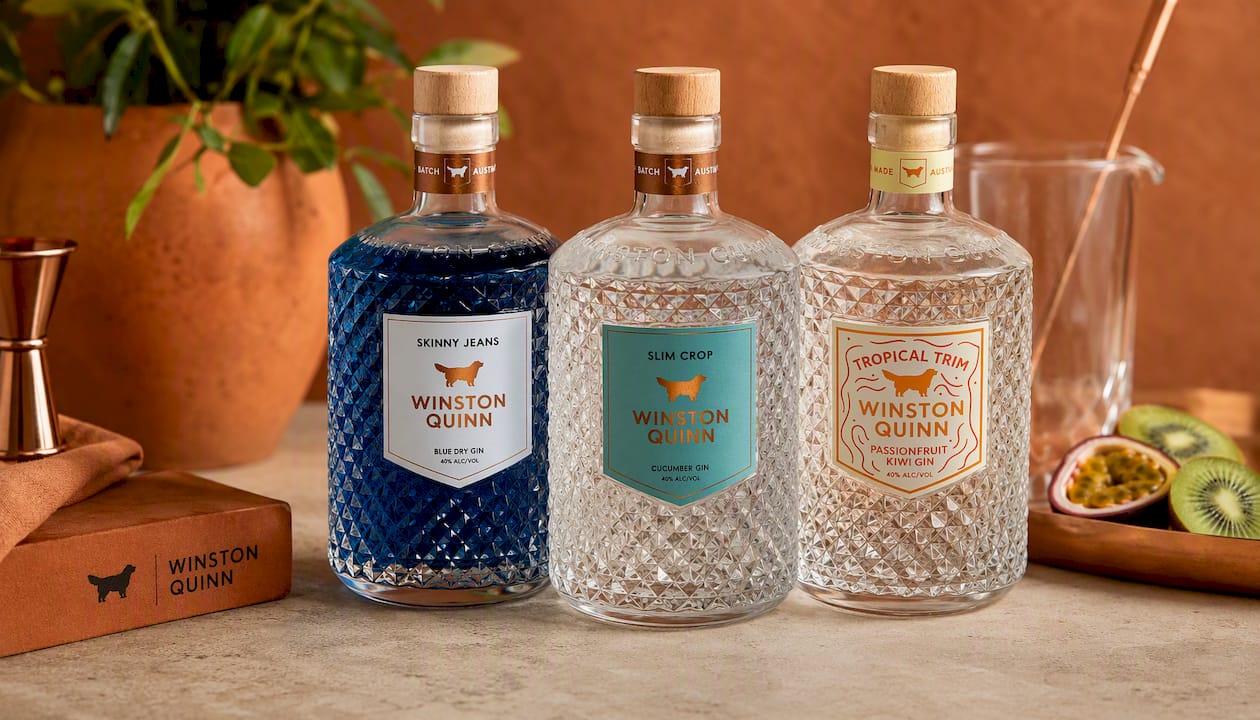
Each product page lists ABV and nutrition details so you can verify the numbers yourself rather than take a marketing claim on faith. Not sure which suits your palate or your diet? Our gin match quiz asks a few quick questions and points you to the bottle that fits, whether that’s a crisp Skinny Jeans Gin for a clean G&T, a cucumber-forward Slim Crop Gin for something lighter, or Tropical Trim if you want fruit character on the label. Have a look at the product pages, check the nutrition panel that matters to you, and pick the bottle that fits your glass.
Sources
- About gin — Australian Bartender
- Gin nutrition facts and health tips — Verywell Fit
- Lab study detecting sugar in flavoured gin samples — Heriot‑Watt repository
FAQ
Is gin the healthiest alcohol to drink?
No single spirit is “healthiest,” but plain gin’s zero-carb, zero-sugar profile makes it a reasonable low-sugar choice compared with sweetened liqueurs or cocktails, provided the mixer stays low-sugar too.
Can diabetics drink gin?
Plain gin contains no sugar, but alcohol can still affect blood glucose and interact with diabetes medications, so check with your clinician first and monitor your levels afterwards.
Which has less sugar, vodka or gin?
Both plain vodka and plain gin are distilled to zero grams of sugar and carbohydrates, so neither has an advantage over the other; the real difference comes down to flavour and the mixer you choose.
What alcohol drink has no sugar?
Plain distilled spirits, including gin, vodka, whisky and plain rum, all carry zero grams of sugar; the safest low-sugar serve is one of these poured over soda water or a zero-sugar mixer.
